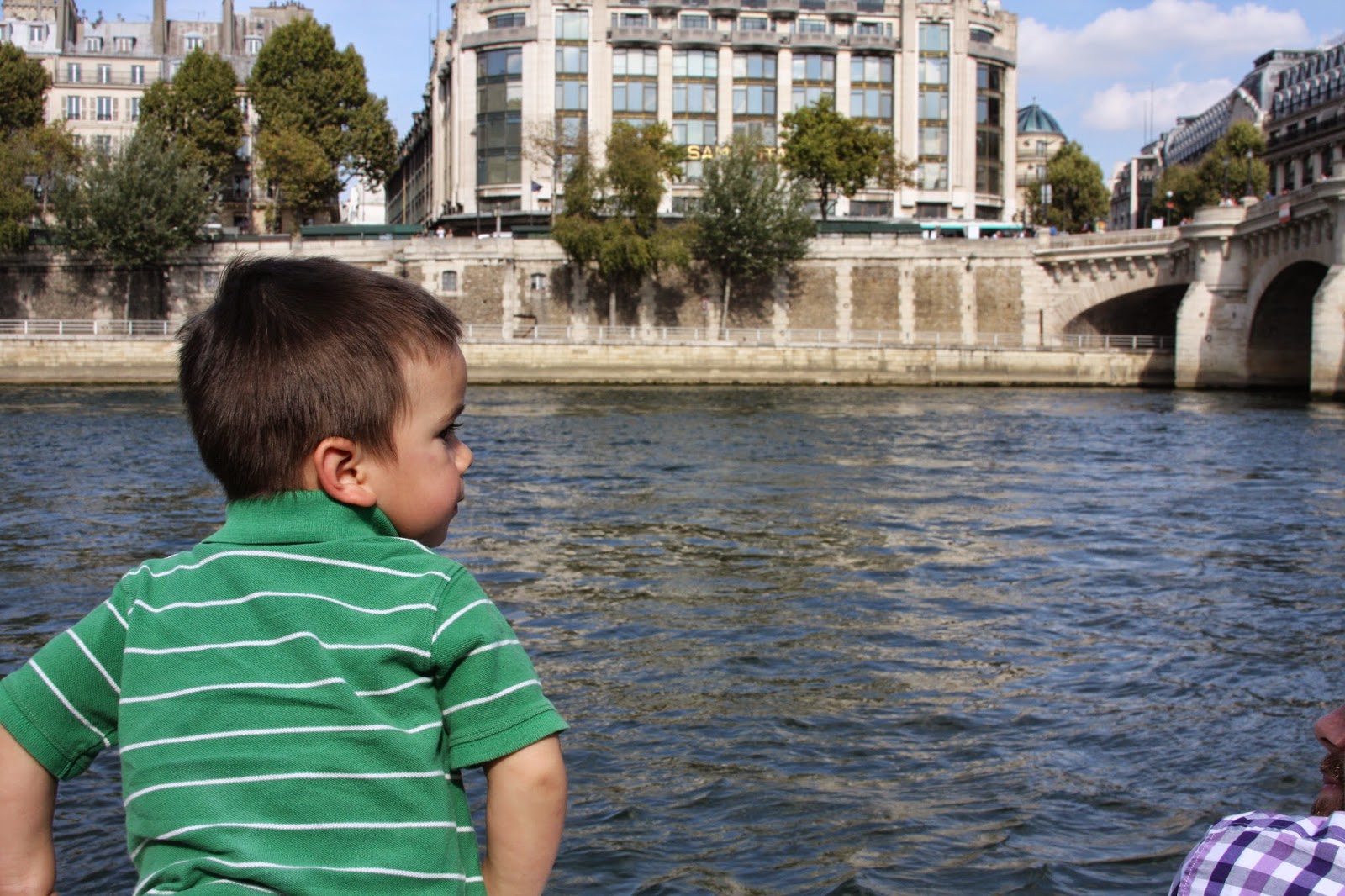
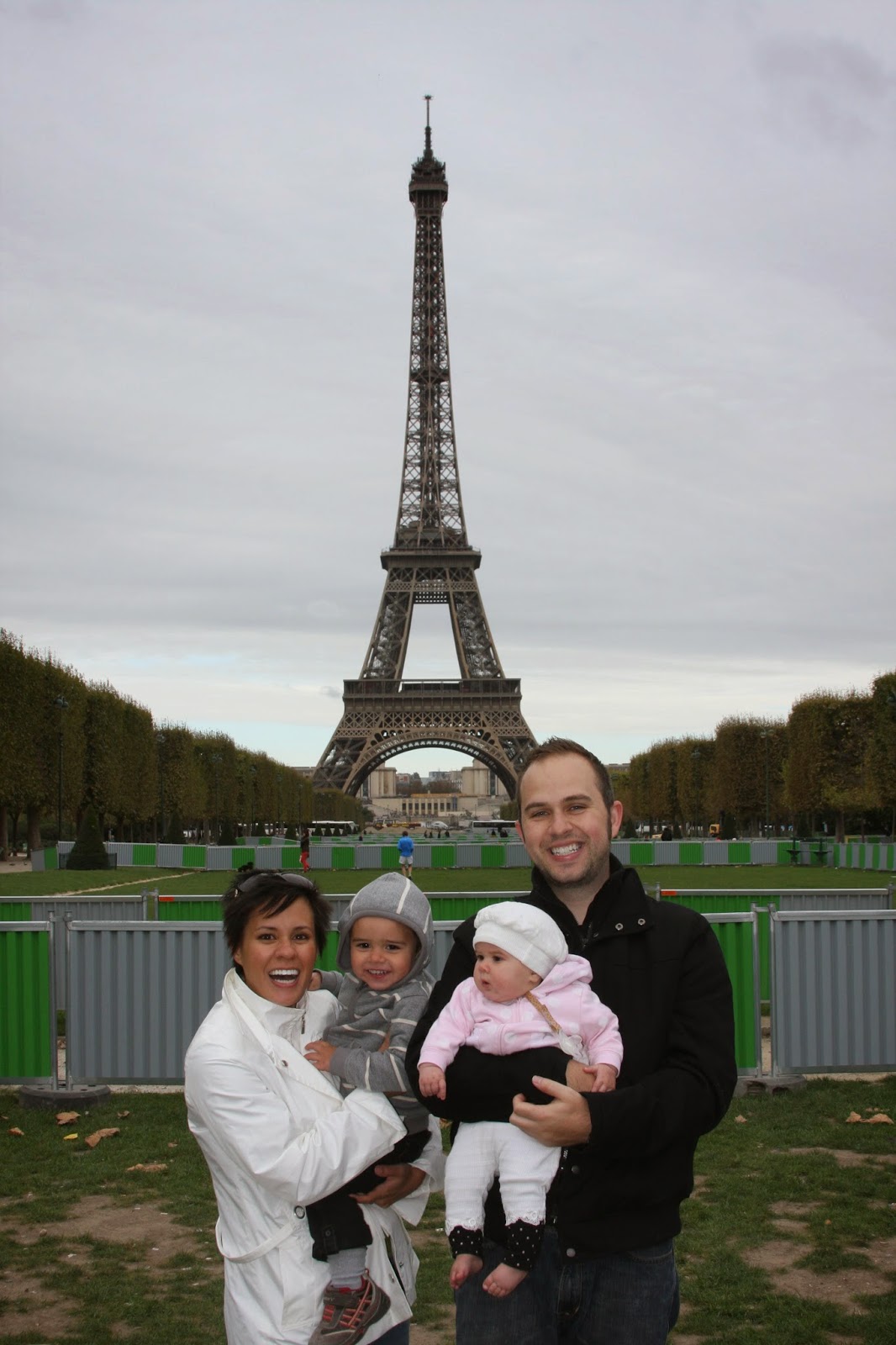
Just one short month until Sebastian turns two. Compared to Livia, he's a giant, but when we to go the playground with bigger kids, I can see he's still just a baby. He is, however, without a doubt, turning more into a boy every day. He's rapidly been adding words to his spoken vocabulary in the last three or four months, and his speech is irresistible to me. Over the last month, he has phased out of his last few signs ("sandwich," "noodles," "thank you," and "music") with the exception of "love," for which he places his fists under his chin when he needs comfort. He has the sweetest voice, and since he's so hard to record, I want to phonetically document his darling toddler articulation and exercise my brain. This collection also showcases Sebastian's interest, behavior, and attitudes all in one place. Also note that these are words that Sebastian produces spontaneously rather that words that he repeats.
airplane - /ˈɑ pin/ - "ah-peen"
Airplane is by far one of my favorite Sebastian words. I love it because it shows how that he knows what he loves. He can spot an airplane from miles (literally) away. He can hear an airplane outside when we are trying to go down for a nap. (This word also sounds exactly like "open," "elephant," and "happy." Context is almost always necessary. Otherwise, they are pretty difficult to differentiate.) Curtis can't wait until the day he teaches Sebastian about Bernoulli. That will be a fun name to say.
(I already posted a video of this word here.)
This word features a common phonological process, cluster reduction. Instead of producing both the /p/ and the /l/ sounds in "plane," Sebastian reduces that cluster, making it easier to say, by eliminating the /l/. Sebastian rarely produces the /l/ sound in any word, but it will occasionally roll off his tongue when he says his sister's name.
Other A words include "again," "apple," "all gone," and "ant."
binkie - /ˈbĩ bik/ - "bee-beek"
We are trying to wean Sebastian of the binkie, but with a new baby sister and moving to a new home every few months, we understand he is going to be a tad bit dependent on it, and that's OK. I also love the way he says blanket: /ˈɑ bik/.
"Binkie" differs slightly from the way he says "baby" (/bi bi/). The nasalization of the first vowel (and the tired whining) give away this word. This word features progressive (or perseverative) assimilation. I know that Sebastian can produce the initial /k/ sound from words like "cookie," "cat," "car," so it's interesting that he's reduplicating the /b/ and moving the /k/ to the final position.
Other B words include "badger," "ball," "banana," "bath," "bear bear," "bee" (his first fear), "berry," "big," "bird," "bitte," "blanket" (/ˈɑ bik/), "body,"
"book," "bread," "bubbles," "bug," "bus," and "butterfly."
Curtis - /kɚːz/ - "Curz"
I thought about using "cat" for C because it was Sebastian's first word. Then "car" is basically his favorite thing ever. But I couldn't resist documenting the way he always calls Curtis "Curtis" instead of "Dad." He's called me "Jessie" just once or twice. I believe this shows how brilliant (and adorable) Sebastian is. He's trying to figure out the rules of language and of this world. He sometimes hears me call his dad "Curtis," so he is trying to mimic what I do. Brilliant!
I must also note that I've been very impressed with Sebastian's ability to produce the final /r/ in "Curtis, "car," and "water." This sound isn't usually mastered in the final position until about five years of age.
Other C words include "caterpillar," "cereal," "chalk," "cheese," "choo choo," "clean up," "cookie" (thanks, Mammaw), and "cup."
doggie - /ˈgɑ gi/ - "goggy"
It's not hard to tell when Sebastian sees a dog in the distance. Animals were among Sebastian's first big interests: His first word was "cat." He asks for Taco (my parents cat) when we call my parents. He adores going to the zoo and watching animal videos on YouTube. He can name most of the sounds that farm and forest animals makes. So, naturally, "dog" was one of his first and most enthusiastic words to learn. In addition to saying this word, he'll generally squeal with delight and point with vigor.
When we go outside for walks, people are always so kind to stop and let him pet their dogs. He loves it. And I love him.
Sebastian frequently backs (changing the /d/ sound to the /g/) his alveolar stops, as heard in this word. Backing is usually a more unusual (and more difficult to fix) phonological process. Usually children change their /g/s to /d/s—saying "dod" instead of "gog."
However, rather than backing, I think this is more an example of regressive, or anticipatory, assimilation (the opposite of what Sebastian does in the word "binkie"). The velar /g/ influences the /d/, and Sebastian anticipates using that velar consonant by changing the /d/ to a /g/.
Other D words include "danke," "diaper," "dinosaur," "drum," and "duck."
egg - /æk/ - "ack"
There was a time when Sebastian wanted eggs every. single. morning. for breakfast. I quickly learned to sneak a handful of nutritious spinach so that he was getting a good amount of veggies per day. (Don't ask me how I "sneak" a bright green vegetable into a pale yellow food.) It didn't take long for Sebastian to learn to say this word since his signs for "egg," "peas," and "bananas" all looked the same.
Besides being cute, this word is an example of final consonant devoicing—the final consonant, /g/, is changed to its voiceless counterpart, /k/.
Other E words include "eat," "elephant," and "eyes."
food - /puːd/ - "pood"
Sometimes I'll wake up in the morning and find Sebastian four inches away from my face sweeting asking for some breakfast. Oh goodness. He's so sweet. He'll say "food" with his cute, cute lips sticking out, and I can't help but give him anything he wants. Except cereal. Because he'll eat four bowls before he's full.
This word is an example of stopping, substituting a fricative (/f/) with a stop consonant (/p/), something that I don't see very often in Sebastian's speech. He is able to produce other fricatives, like /s/ and /z/ (although sometimes dentalized), in other words.
Other F words include "fast," "fish," and "flower."
get out - /gaʊk/ - "gouk"
This phrase is newly developed and frequently used. It seems that Sebastian is always desperate to get out of something—whether that be a shopping cart, car seat, booster seat, his bed, or the house. One thing is for sure: This boy loves move. He loves to be free and play and run (in circles) if he so pleases. And I love that. I love that he can use his body and explore the world.
This word is another example of progressive assimilation. The velar /g/ sound influences the alveolar /t/ sound, changing it to a velar /k/. Sebastian is fully capable of producing the /t/ sounds, but in this word, the first velar consonant influences the second consonant.
Other G words include "get off," "get it," "giraffe," "glasses," "go," "grandma," "grandpa," and "grapes" (/t̪æs̪/).
"Giraffe" also illustrates another remarkable skill in language acquisition. Many children will lump all four-legged animals under one vocabulary word (if only for a short time), calling all cows and tigers "dogs," for example. Sebastian, however, has never done this—according to my observation. I was amazed the morning he pointed to Livia's pajamas and labeled the figure on them "giraffe." How did he know that? He keeps reminding me to never underestimate his ability as a learner.
happy - /ˈæ piː/ - "appy"
I love that Sebastian is starting to recognize emotions in other people, especially in his sister, Livia. This is a skill that is difficult for many children, but Sebastian has always seemed to read into the emotional cues of children around him. I first noticed it when we attended playgroup in Vancouver. A baby girl, strapped in her carseat, might be crying while her mom attempted to break up her older two siblings. Sebastian would skip over to her, place his hands on either side of the carseat, and babble at her with his head tilted sideways. He would bring her toys or place a ball on her face—something he still does for Livia. Even though "sad" is an important emotion to recognize, he's recently started pointing out when children are happy. We see them at the playground. We see them in books. And we see happiness in our family.
Removing the /h/ in "happy" is a common example of initial consonant deletion. Many H words, in fact, feature this phonological process. Interestingly, for Sebastian, he removes the initial /h/ sound in all H words except for one—"hot"—in which case he articulates
only the /h/.
Other H words include "hair," "happy," "hat," "helicopter." "help," "hot" (his second word, meaning "fire"), "hotdog" (/ˈaʔ gɑg/),
"house," and "hurt" (of course).
ice - /aɪs̪
/ - "ites"
The hot Carolina summer begs Sebastian daily to play outside. But it's hot. So I gave the boy a plain ol' bowl of ice. It was a hit! He asks for ice nearly every time he plays outside, but what's so cute about this word is his sign for it: He points to his eye. Clever boy.
I've noticed that Sebastian's voiceless alveolar sounds (/s/ and /t/) are dentalized—his tongue is pushed forward, on his teeth. When Sebastian first started making the sound for a snake, he would actually place his tongue between his teeth. It's an advanced articulation that will come in handy when he starts producing more words with the /θ/ and /ð/
sounds, but right now it sounds like a mild lisp.
Other I words include "I want."
Jesus - /t̪iːz/ - "tseez"
The first time I realized what Sebastian was actually saying, I thought he had been asking for cheese. Until I saw he was looking at our illustrated Book of Mormon. This moment was really special for me because neither I nor Curtis had taught him to say "Jesus" specifically. He heard Jesus' name in prayers and saw His picture in the hallways at church, but it was Sebastian who initiated learning about Him from books. Sebastian already has such a kind heart, and I'm excited for him to start wanting to be like the kindest heart we know.
"Jesus" and "ka-chow" both feature deaffrication. The affricate sounds "j" (/dʒ/)
and "ch" (/tʃ/) are replaced with non-affricate sounds. In Sebastian's case, he simplifies these sounds to a dentalized /t/, meaning the /t/ sound is articulated slightly forward, causing a lisp-sounding /t/.
Other J words include "jam" and "jump" (of course).
ka-chow - /ə ˈt̪aʊ/ - "uh-tsow"
I see a few trends in the words that Sebastian has interest in saying: first, food; second, animals; and third, vehicles. He loves cars. And he loves
Cars. Curtis and I aren't keen on allowing Sebastian to have much screen time, but sometimes, it's a necessary evil. We started watching Curious George so that I could have some free time to put dinner on the table right as Curtis came home. Then I started reading more about
building creativity and independence in toddlers. Sebastian is able to play by himself like a champ on most days. He is creative with the few toys he has, and I'm really proud of his ability to entertain himself and take control of his play. But, alas—you know the days I'm talking about. Those are the days we watch
Cars. "Kachow" refers to the hot-shot racecar on his journey to self discovery, Lightning McQueen.
Most often, he deletes the initial consonant, but it's also not unusual to hear the /k/. But most importantly, he loves saying this word. In this video clip, he's holding a package of hand wipes with Lightning McQueen on the front. Excuse his dirty face and clothes-less body. I'm a good mom.
Other K words include "kick."
Livia - /ˈɑː i ˌjə/ - "Ah-ee-yuh"
I love the way Sebastian says "Livia." Or maybe I just plain love that he says "Livia." When we brought Livia home from the hospital, Sebastian tried to rip the blanket from her that she was swaddled in. He was mad. He quickly learned that she was here to stay, and now it isn't rare to find him sharing toys and kisses with this angel baby. I once found her with a clean diaper covering her face. She was a bit fussy, so Sebastian gave her what he thought would help the most. Sweet boy.
/l/ is developmentally an advanced sound to make, and it may be too early to tell whether or not Sebastian will have trouble with it. I do hear it sneak in on occasion, so it's likely that Sebastian will be find producing this sound in the future. But in the meantime, Sebastian usually substitutes the /l/ with a vowel or /j/.
Other L words include "legs" and "light."
Mom - /mɑm/ - "mom"
I just must include this word. It almost makes me teary just thinking about his voice as he shouts my name from behind the nursery gate at church. He was the first one who touched my heart from within. He was the first one who changed my whole outlook on life. He was the first one who made me a mother for the rest of my life. He always says it perfectly. He always says it with devotion and delight. And maybe that's my favorite part.
/m/ is one of the first phonemes that children usually master, which—fortunately for me—makes "mom" one of the easiest words to say. /m/ is a bilabial sound, meaning it is produced by articulating both lips. And lips are the first muscles a baby uses—to suck. It is no wonder that "mama" is a term used universally, no matter which native language a baby hears. Sebastian, however, said "cat" before anything else. Then "hot." Then "dad." Then a few other irrelevant words before he got to "mom." At least he says it now . . . .
Other M words include "Mater," "McQueen," "milk," "monkey," "more," "moo," and "music."
no - /noʊ/ - "(Do you really need a translation?)"
I once read a statistic that the average toddler hears the word "no" more than 400 times per day. To me, that's a sad representation of a toddler's emotional and linguistic environment.
We rarely use the word "no" with Sebastian to forbid him from doing something, but it's still a word that pops up every now and then. I chose this word for N because not only does Sebastian say it perfectly, he uses it constructive ways. Rather than using it as an I-don't-care-what-you-say-I-hate-all-things blanket negative, Sebastian uses "no" to tell us his decisions. If we ask him if he wants to eat chicken or peas, he might say, "No chicken!"
Another N word is "nice." He says this almost exclusively when we are changing his diaper. On the occasions he gets diaper rash, he
hates getting his diaper changed. But we flash a tube of petroleum jelly and say, "But this will make it feel nice!" Suddenly, every diaper change he brings me that tube and says, "nice."
Other N words include "nap," "nose," and "noodles."
outside - /ə̆ ˈs̪aɪː/ - "uh-sai"
I remember the first time Sebastian's feet met grass. He hated it. But it seems natural for babies to shun the unfamiliar. But now that Sebastian is big and two, it's like he needs fresh air as much as he needs, well . . . air. I suppose that explains it.
This word is one of the few that is always spoken with a question intonation. While every other word goes from high to low, this word is almost always requesting permission. And it comes with an irresistible grin.
Other O words include "oatmeal," "off," "one," and "open."
poopy - /ˈpu pi/ - "poopy"
Another letter with so many other possibilities. I love the way he says "please" (/piːs̪/) and "play" (/peɪ/), but "poopy" (I'm sorry) was a huge milestone for us. We know that one of the prerequisites for potty training includes recognizing the urge, which Sebastian has been able to do for a while now. For the better part of this year, Sebastian has alerted us that he would like his diaper changed by making eye contact and tapping on his diaper. This act was also one of the first ways Sebastian initiated communication. To me, that was huge! Unfortunately, another prerequisite to potty training is being able to sit still for a few minutes. That, my friends, has definitely not been mastered.
/p/, like /m/, is another bilabial sound, which makes it another easy sound for toddlers to make—which also makes "poopy" an easy word to say correctly.
Other P words include "pancakes" (/ˈpĩ pĩk/), "park," "peanut butter," "peas," "pig," "pineapple," "pizza," and "plate"
q
I don't think Sebastian says any words that begin with Q. He certainly doesn't know the meaning of "quiet."
raisins - /wiːs̪/ - "rees"
I taught Sebastian the sign for "bubbles" early on, but it wasn't long before he started signing for them and being frustrated that he was getting exactly what he asked for. Then I noticed the box of raisins on the counter and thought, just maybe . . . . I don't have any clue how to sign "raisins," but Sebastian came up with his own confusing way.
Sebastian can (impressively) produce the /r/ sound after a vowel, but still substitutes a /w/ for the /r/ (gliding) when it occurs before a vowel.
Other R words include "rabbit," "rain," and "rock."
Sebastian - /ˈbæ bɪs/ - "Babis"
Sebastian rarely refers to himself by name. I think that's normal for most kids. But when he does, he gets the most so-proud-of-myself grin on his face, where his eyes squint and I can see every tooth in his mouth. His name was one of the first words he responded to, a milestone for children in the early language development. We have a photo book of Sebastian's first year. We go through that book and identify people and things in the pictures, like Mimi or Curtis, but identifying Sebastian illustrates an interesting notion of Self. He points to pictures of himself from birth to around eight months and says "baby." But through the rest of the book, he labels himself as "Babis." Interesting, isn't it?
The syllable deletion in this word (chopping off the unstressed syllable) is completely normal for toddlers his age. The thing is that we don't see many words that contain more than three syllables in a toddler's vocabulary. One of the first three-syllable words that most parents notice is the pronunciation of /ˈnɛ nə/ for "banana." Sebastian can actually say "banana" correctly—unless he also wants peanut butter (which is most of the time)—in which case, he says "baaaapeanutbutter" (/ˈbʌː p ??? bɝː/. I love it!
Sebastian reduces the "-stian" (/stʃɪn/) to "-bis" (/bɪs/). Clusters, not to mention a fricative-affricate cluster, are naturally more difficult to produce than a single bilabial stop (/b/), so Sebastian combines cluster reduction and stopping for this part of his name. However, I believe he compensates for those processes by substituting /s/ for the /n/ at end of his name. Interesting again!
Other S words include "sad," "salt," "sandwich," "shirt," "shoes," "sit," "snack," "soap," "socks," "strawberry," "stuck," and "swim."
truck - /gʌk/ - "guck"
Whenever we hear the grumble of a diesel engine, Sebastian freezes, looks at me with urgency, and whispers "truck." He then runs outside as fast as he can to catch a glimpse of the passing truck from our back porch.
This word is another example of regressive assimilation, just like in the word "dog." The final /k/ sound influences the initial /t/ articulation so much that it changes it.
Other T words include "tall," "teeth," "tiger," "too," "toothbrush," "toothpaste," and "towel."
uh-huh - /ˈʌ hə/ - "uh-huh"
OK, so his articulation is spot-on on this one, but it's just the way he says it that I love. It's near impossible to describe his sing-songy, high-pitched-then-fallingplummeting-but-still-jubilant intonation, but it's one of those words that I swear I'll never forget.
Almost all of his words (other than when he's asking a question) follow the same intonation pattern: an exaggerated high-low change in pitch. His intonation, I like to think, reflects his exaggerated-but-joyful personality. When he answers my "Did you like the . . . ?" questions, his cheerful intonation tells me more about his answer than his words do.
His other U word is "uh-oh" (too common for my liking).
v
I wish I could put "vacuum" on this list, but I've only speculated hearing it on one occasion. It was one of those times when I couldn't quite figure out what he was trying to say, but looked around and tried to connect the dots. It would make sense that Sebastian would try to say "vacuum" because he loves when I turn it on. He plays with it and wants to plug it in all the time. But he hasn't quite said it consistently enough yet for me to be able to transcribe his pronunciation. Sad.
water - /ˈwɑ ɚ/ - "wa-er"
Curtis and I parked on the side of the road to check out a local garage sale when he said it out of no where. "That's a house, Sebastian," we corrected. It was then we heard it too. There was a small stream running along the end of the street. How incredible, we thought. He was able to recognize different forms of water. We were sure that we had only experienced water he could drink and water he could bathe in. But Sebastian extended that word, all on his own, to describe water in nature. This extension of one word for multiple meanings is opposite of the way he is able to differentiate among different animals in the "four-legged animal" category. Both skills are extremely remarkable and illustrate just how intelligent young toddlers are.
Other W words include "walk" and "wall."
x
No X words either. Don't worry, Sebastian. I don't know that many myself.
yucky - /ˈʌk i/ - "ucky"
Now, I'm not proud of this one, but he totally picked this up from me. I'm just not sure what else I can say to stop him from playing with the poop that some irresponsible dog owner left near the playground.
His other Y word is "yes" (even though it usually takes some prompting).
z
No Z words either. I suspect his first will be "zoo." Or "zepplin." Or "zucchini." Or "zig zag." Or "zinger." Have you ever noticed how strange looking the letter Z is?
Well, there you have it. A necessarily long, comprehensive list of Sebastian's words and examples of (and reasons for) his pronunciation. If this post hasn't helped you appreciate the brain, take a moment to watch "The Linguistic Genius of Babies" by Patricia Kuhl.
Before I close, note that not only is this list adorable, it tells a story. The content of this list tells a story about what we can learn about our children from language. I know what Sebastian loves. I know how Sebastian keeps trying—because these words used to be babbles. I can learn how Sebastian makes connections in our big, big world. And I know that Sebastian is constantly taking in everything in this big world because he adds to this list every day.